

Laos: Navigating Empires and Currents
A Deep Dive into the Landlocked Nation's Geopolitical History, Colonial Struggles, and Modern Economic Revival Through Sino-Lao Ties

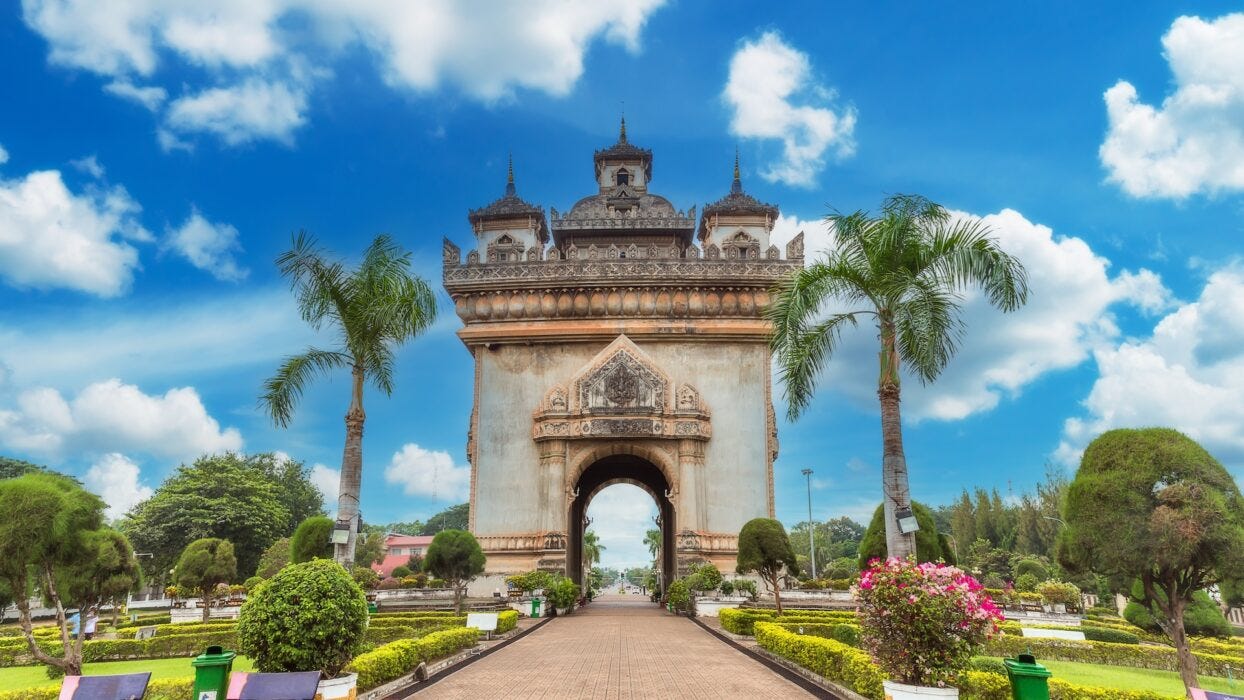
👋 Hello and welcome to this week’s country of Laos. Every country is a puzzle. Join me in assembling them to see the grand picture of humanity, power, and destiny.
The “Landlocked Heart”: Nestled deep in mainland Southeast Asia, serving as a strategic crossroads connecting its neighbors.
Shaped by Mountains and Rivers: Majestic mountain ranges and sprawling rivers have carved the nation’s stunning landscape.
A Jewel Between Empires: For centuries, it has resiliently written its own history on a geopolitical stage surrounded by powerful neighbors.
Geopolitical Terrain and Ancient Roots
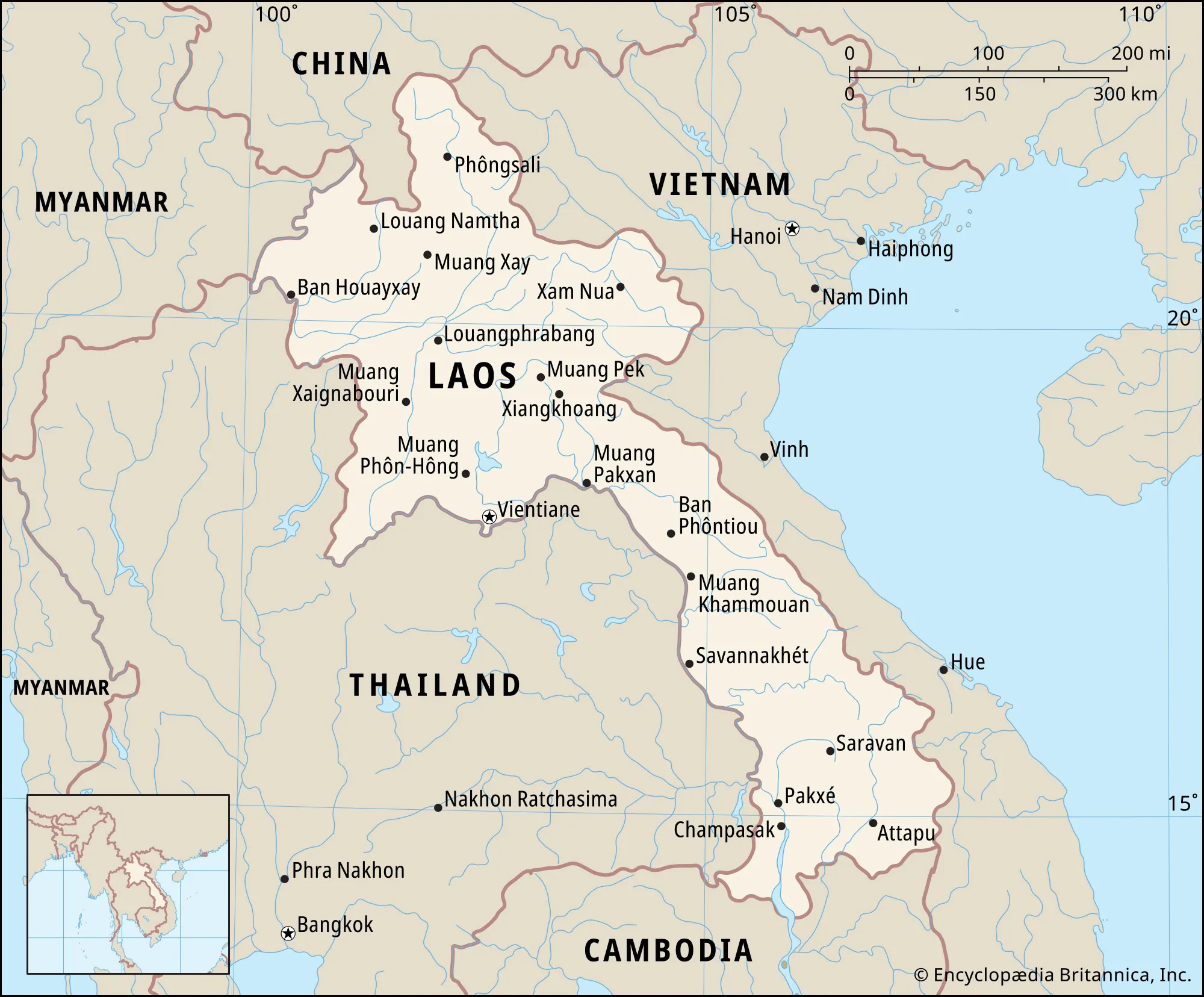
Laos, officially the Lao People’s Democratic Republic, sits right in the heart of the Indochina Peninsula, sharing borders with Vietnam, China, Myanmar, Thailand, and Cambodia. It covers about 91,400 square miles (236,800 square kilometers) of land and has a population of around 7.45 million people.
The country’s landscape is dominated by mountains and hills, making up about 80% of its territory, and it gets plenty of rainfall throughout the year.
However, due to its relatively underdeveloped economy, many rural areas still rely on traditional slash-and-burn farming methods, resulting in hazy skies for 50 to 100 days annually.
The Mekong River is Laos’s most vital natural resource—known as the Lancang River up in China.
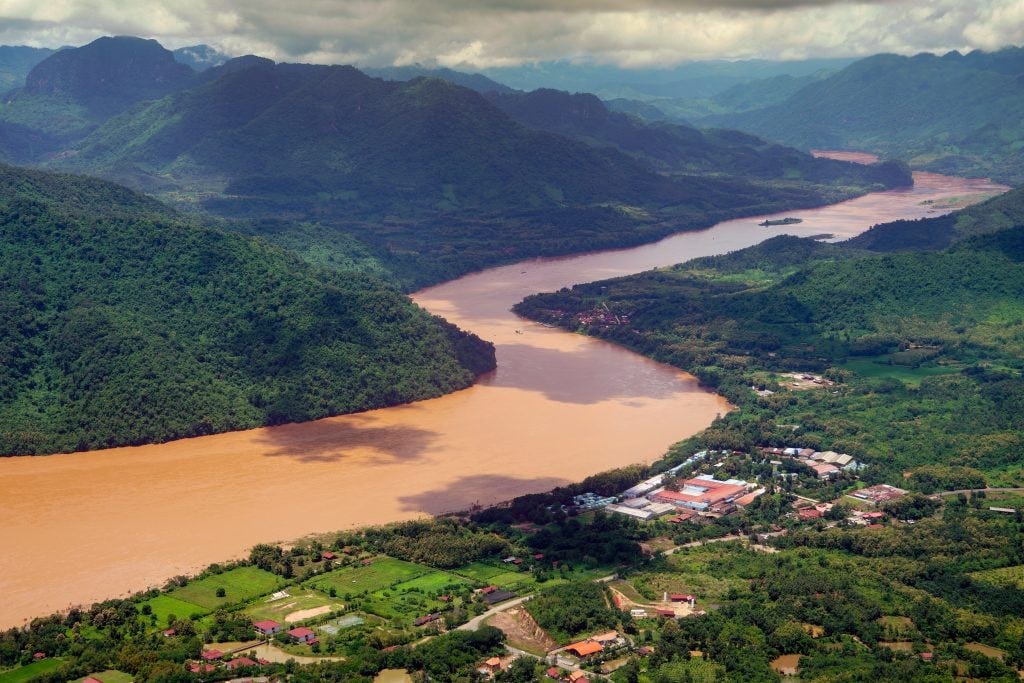
It flows from north to south straight through the country, forming much of the border with Thailand and Myanmar, and supporting the majority of the population along its banks.
To the east, the Annamite Mountains serve as a natural barrier between Laos and Vietnam. As a small, landlocked nation surrounded by rugged terrain, Laos’s fortunes are shaped not just by global events, but also by the push and pull of regional geopolitics.
Southeast Asia is packed with mountains, hills, and thick forests, without much in the way of wide-open plains. That’s why the region never developed a single, all-powerful empire throughout its history.
Back in ancient times, rulers usually only held sway over their capital and the nearby areas. Calling yourself a “major power” simply signified a larger number of smaller tributary states.
These smaller states would often pay tribute to multiple major powers simultaneously, which led to the formation of a political structure known as the mandala system.
Over the years, three stronger players have stood out in the area: Burma (now Myanmar), Thailand, and Vietnam. The smaller countries have had to play a delicate balancing act to survive among them.
Running from southwestern China all the way down to Thailand, there’s this cultural umbrella known as the Tai Peoples.
“Tai” here is a technical term in linguistics and ethnology, grouping together ethnic communities like the Thai, Dai, Zhuang, Bouyei, Shan, and Lao, who share similar languages and traditions.
In this distinctive mix of geography and politics, these communities built a foundational social structure known as the “muang.” Depending on regional accents, it might get spelled as “man,” “mang,” or “meng.”
At its core, a “muang” started out as a fortified town along with its outlying villages. Over time, it turned into a full-fledged political entity that could scale from a modest village right up to a whole kingdom, creating a setup where smaller “muangs” paid tribute to the bigger ones.
For instance, in everyday talk, people still call Thailand “Muang Thai” and Laos “Muang Lao.”
During the Ming and Qing dynasties, China rolled out the “gaitu guiliu” reforms in Yunnan to replace local chieftains with central officials, and later, as Western colonizers pulled Southeast Asia into the fold of international law, the “muang” system slowly vanished. That said, plenty of those names have hung on in various spots.
Ancient Chinese chronicles refer to “Zhenla,” which encompassed areas that are now part of Laos.
During the Tang Dynasty, Zhenla traded with the Nanzhao Kingdom, which is why many Lao people trace their royal lineage back to Nanzhao’s rulers.
For Laos, the standout ancient dynasty was Lan Xang, founded in 1353.
This kingdom paid tributes to both China and Vietnam, and Ming Emperor Yongle even went so far as to conferred upon its king the “Military and Civil Pacification Commissioner of Laos.”
In 1707, Lan Xang fractured into three smaller kingdoms—Luang Prabang, Vientiane, and Champasak—all of which ended up as vassals under Thailand (back then called Siam).
By the end of the 19th century, as imperialism ramped up globally and China’s old tributary network crumbled, France had already snapped up Vietnam and Cambodia.
From a strategic standpoint, France was eyeing a direct path into China, with the Mekong River serving as the prime waterway.
Given that stretches of the Mekong run through Laos, the country turned into the missing link in France’s Southeast Asian colonial empire.
Right around this time, the “Haw Wars“ provided an opportunity for France to intervene.
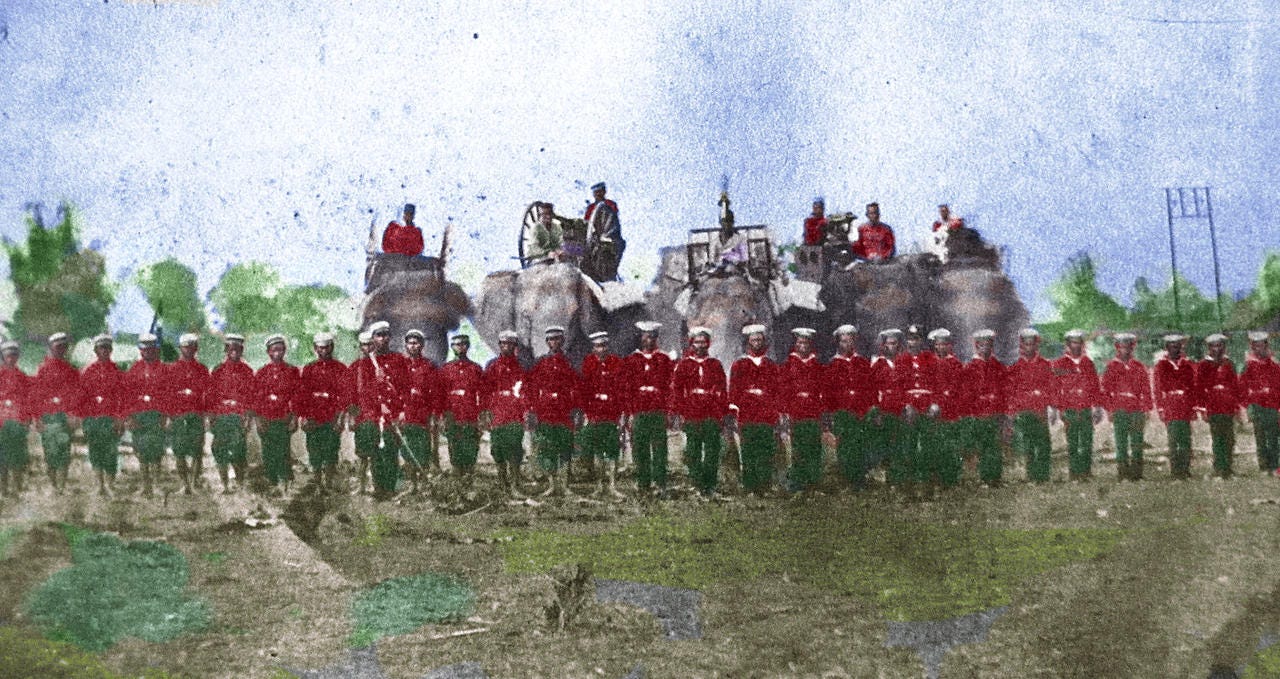
The conflict kicked off after China’s Taiping Heavenly Kingdom movement collapsed, when a ragtag group from the Red Flag Army shifted from Yunnan into Laos and started pillaging left and right.
Laos turned to its overlord, Thailand, for backup. The Thais lumped these Han Chinese fighters from Yunnan together as “Haw,” which is how the wars got their name.
But the Thai troops were no match for them. As the standoff dragged on, France swooped in under the banner of restoring peace—not only crushing the Red Flag Army but also using the chaos to undercut Thailand and ultimately snatch control over Laos.
From that point forward, Laos got swept up in the tides of modern history.
During the colonial period, France’s governing style stood apart from Britain’s. Shaped by the Revolution and republican ideals, the French were more inclined to run their colonies like extensions of the motherland.
They propped up puppet royal families to lend some legitimacy to their rule, while bringing in a bunch of French-speaking Vietnamese to fill civil service jobs, which created this clear-cut social pecking order: French at the top, then Vietnamese, and Lao at the bottom.
At the same time, the French set up schools to groom local Lao talent, got rid of slavery, and made efforts to roll out French-style education and healthcare systems—but funding shortages meant those initiatives fizzled out pretty quickly.
For the Lao people, who were accustomed to the mandala system, it was basically just swapping one overlord for another: Thailand out, France in, with the king still in place, only now under a much bigger “muang.”
So, aside from a few uprisings against taxes, things stayed relatively calm across society.
On the economic front, with all those mountains and sky-high transportation costs, French efforts to develop the place were pretty minimal.
They only set up a handful of mines and dotted a few plantations along the Mekong River, but the colonial investments dwarfed any real payoffs.
To offset the deficits, French colonizers even pushed the Lao to cultivate opium and peddle it to Chinese buyers.
Nevertheless, French rule had the unintended effect of sparking Lao national consciousness.
Every year, France cherry-picked a batch of Lao aristocrats’ kids to study abroad in France, hoping to mold them culturally. But along with diving into French lit and café vibes, these students picked up on nationalist vibes too.
To curb Thai sway, the French rolled out a “de-Thaification” push in education, outright banning Thai language use.
These homecoming elites then settled on the most common Lao ethnic dialect—the official lingo from the old Lan Xang days—as the national tongue, and went hunting for ancient stone carvings to piece together a standardized version.
By 1935, a revamped Lao language had taken shape, serving as the go-to official language in French-controlled Laos.
After World War II broke out, France surrendered in 1940 and set up the Vichy puppet regime.
Japanese forces soon moved into French Indochina as supposed allies, establishing military bases there.
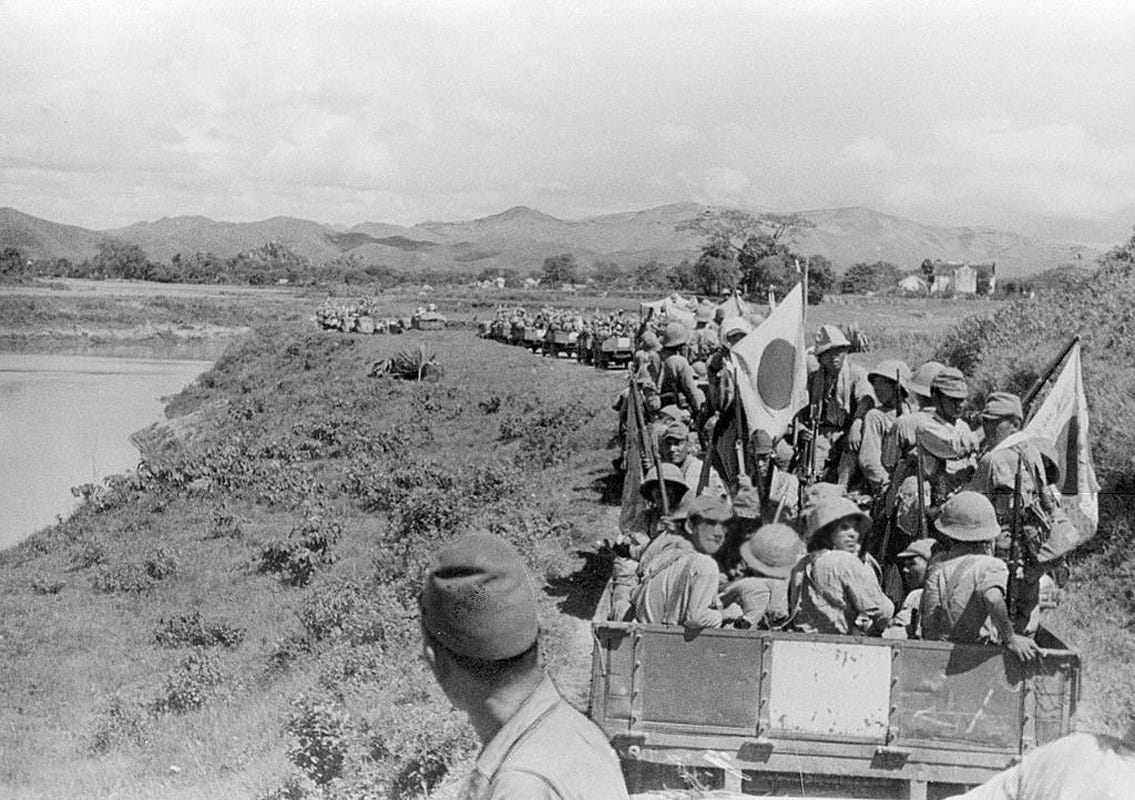
Neighboring Thailand, spotting France’s weakness, jumped at the chance to declare war on the colonial government while secretly reaching out to Japan, offering support for their invasions of Burma and Malaysia.
In return, Japan stepped in as a mediator, pressuring Vichy France to cede about 21,000 square miles of territory to Thailand, which shaped the modern Laos-Thailand border.
This whole episode opened the eyes of many Lao people to the risks of relying on a fading “big muang,” sparking early ideas about building an independent Lao nation.
In 1945, as the Allies toppled Vichy France, Japan moved first to block the de Gaulle government from reclaiming Southeast Asia by seizing control of all of Indochina, prompting Vietnam, Cambodia, and Laos to declare independence from France one after another.
Independence Struggles and Revolutionary Triumph
After World War II ended with Japan’s surrender, Laos stood at yet another pivotal crossroads.
The king was eager to welcome the French back, but the patriotic Prime Minister Prince Phetsarath launched the “Lao Issara“ independence movement.
That October, he proclaimed the creation of the Kingdom of Laos and rolled out a constitution on behalf of the entire Lao people.
However, French forces stormed back in no time, driving the pro-independence leaders into exile in Thailand.
Though this push for freedom didn’t last long, it effectively spread nationalist sentiments from the educated elite to ordinary citizens. Prince Phetsarath became known as the “Father of Independence” for it, and he’s still held in high regard by the Lao people to this day.
From then on, while France reclaimed authority over Laos’s diplomacy and military, they were hands-off when it came to internal affairs. The worldwide surge of national liberation movements had become an irresistible force.
Kaysone Phomvihane was born in 1920 and headed off to Vietnam as a young man to pursue his education, joining the Indochinese Communist Party in 1946. It was there that he crossed paths with his lifelong ally, Prince Souphanouvong.
Souphanouvong, the brother of “Father of Independence” Prince Phetsarath, was adamant that Laos could only secure its freedom with solid support from Vietnam.
After linking up with Ho Chi Minh and drawing deep inspiration from him, Souphanouvong also signed on with the Indochinese Communist Party.
From that moment, Kaysone and Souphanouvong teamed up for a revolutionary path fought shoulder to shoulder.
At the time, Laos lacked any serious industrial backbone or working class, intellectuals were scarce, and the government hardly bothered taxing agriculture, making pure left-wing messaging a tough sell.
That’s what made Souphanouvong, with his royal pedigree, the ideal spokesperson for the movement—he earned the moniker “Red Prince” for it.
He and Kaysone became a classic front-and-center duo, one public and one in the shadows, and they went on to establish the Pathet Lao as a united patriotic front.
The organization zeroed in on “fighting for national independence” as its core goal, pulling together every patriotic group out there. Its clear, no-nonsense slogans had way more appeal than the tangled web of communist ideology.
In 1954, Vietnamese revolutionaries handed the French a crushing defeat at the Battle of Dien Bien Phu, which straight-up toppled the hawkish cabinet back in France.
Not long after, the U.S., Soviet Union, Britain, France, China, Vietnam, Laos, and Cambodia all sat down in Geneva for negotiations. France was forced to let go of its entire colonial grip on Indochina, paving the way for Laos, Vietnam, and Cambodia to gain full independence.
With the fight against France in the books, the whole “Indochina” as a geopolitical concept faded away.
By 1955, the old Indochinese Communist Party opted to break into independent outfits for each nation, each steering its own revolutionary course.
That said, thanks to imperialist interference, Vietnam ended up split into North and South, with the U.S. filling France’s shoes and ushering in the Vietnam War era.
Laos’s fortunes stayed tightly linked to the ups and downs in Vietnam as a result.
The Vietnam War built up gradually. From 1955 to 1963, the conflict hadn’t ramped up too intensely yet, giving Laos room to experiment with a coalition government that brought together pro-U.S. factions, neutrals, and the pro-Vietnam Pathet Lao.
Even with their clashing ideologies, the leaders were mostly connected through royal bloodlines, which kept things relatively harmonious.
Nonetheless, for North Vietnam, the Ho Chi Minh Trail—winding through Laos and Cambodia to shuttle supplies and troops down to South Vietnam—was an absolute strategic lifeline.
With its prime geopolitical position, Laos quickly became a flashpoint in the U.S.-Soviet tug-of-war.
The U.S. dove in headfirst to bolster anti-Pathet Lao groups, with the CIA even funneling military support to Vang Pao, the anti-communist Hmong warlord inside Laos, to launch strikes against the Pathet Lao.
Later, the U.S. reckoned that a government run by princes wouldn’t crack down too harshly on the Pathet Lao—after all, it was led by their own kin—so they went ahead and toppled the coalition outright, propping up a military junta instead. That move lit the fuse for a full-scale civil war in Laos.
As the U.S. plunged headlong into the Vietnam War in 1963, American forces kicked off widespread bombing runs over Vietnam, Laos, and Cambodia.
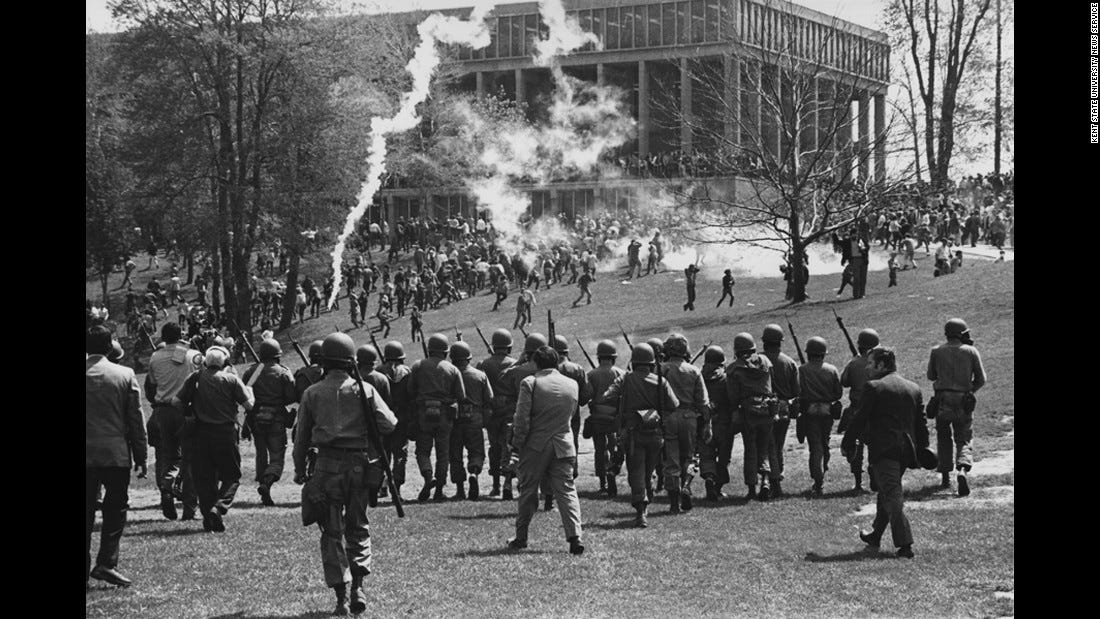
By the numbers, the U.S. unleashed more than 2 million tons of bombs on Laos alone, packing an explosive punch roughly 100 times that of the “Fat Man” atomic bomb dropped on Nagasaki in Japan.
The military regime the U.S. backed was riddled with corruption and incompetence, boasting lousy fighting power, and it only really held sway in urban spots where American troops were on the ground.
The book Shadow War: The CIA’s Secret War in Laos dives deep into the royal coalition government in Laos during the Cold War, the power plays between the U.S., Soviet Union, North and South Vietnam on Lao soil, and how all that upheaval shook up local society.
In contrast, the communist guerrillas hunkered down in the mountains kept gaining momentum with each clash.
By 1972, the Pathet Lao had freed up three-quarters of the nation’s territory and half its people, connecting the northern and southern liberated areas into one seamless zone while rolling out democratic administrations at every level.
Leveraging the Ho Chi Minh Trail, the Pathet Lao didn’t just keep lines open with the North Vietnamese government—they also ventured deep into the highlands, bringing ethnic minorities into the fold.
In 1975, the Vietnam War finally wound down. That same year, on December 2, the Lao royal family abdicated, paving the way for the official launch of the Lao People’s Democratic Republic. Souphanouvong stepped up as president, with Kaysone taking the prime minister spot.
Economic Reforms and Sino-Lao Collaboration
The new leadership signed a 20-year friendship and cooperation deal with Vietnam, kicking off a whole new era of tight-knit ties.
Laos’s bigwigs had been rubbing shoulders with Vietnamese communist higher-ups since their early years, and a ton of their schooling programs and propaganda stuff were basically direct lifts from Vietnam.
Vietnamese advisors popped up in every corner of Laos’s government institutions, from top to bottom, and leaders from both sides would even team up to mark Ho Chi Minh’s birthday.
Due to this special connection, China-Laos ties stayed pretty subdued through the 1970s, except for that one highway China pitched in to build.
However, buddying up with Vietnam didn’t do much to tackle Laos’s core issue—grinding poverty. The French colonizers never figured it out, endless wars just piled on the misery, and the Vietnamese after the conflict were equally at a loss.
Laos was flat broke in those days. U.S. reports noted that the biggest crook from the old regime, Prince Boun Oum, had scraped together a fortune of just $400,000—but that still crowned him the wealthiest around.
Kaysone held onto power right up until his death in 1992, and Souphanouvong followed in 1995. They ran the show for decades, keeping the government steady as a rock without any big-time political squabbles.
The country was so strapped for cash that even pulling in agricultural taxes was a nightmare. Early plans for collective farms got washed away—literally—after a massive flood.
By the mid-1980s, more than 90% of the population was still farming for a living, putting Laos squarely among the world’s least developed spots.
Even though relations between Laos and China had been lukewarm for a while, Laos was heavily shaped by the Vietnamese Communist Party, which in turn drew a lot from China’s reform playbook.
China kicked off its reform and opening-up in 1978. By 1986, Vietnam and Laos followed suit with their own “Doi Moi” and “Chintanakan Mai” initiatives.
In 1987, Laos rolled out household contract farming systems. And by 1989, Vietnamese troops had fully pulled out of Laos, warming up China-Laos ties once more.
Spurred by these “new thinking” policies, business in Laos started buzzing, giving rise to standout brands like Dao Coffee and Beerlao.
Beerlao, for one, commands a whopping 99% of the domestic market and exports to Thailand and China’s Xishuangbanna region.
In the early ‘90s, China, Laos, Myanmar, Thailand, Cambodia, and Vietnam teamed up to launch a subregional cooperation effort centered around the Lancang-Mekong River basin.
Thanks to its relatively cheap workforce and the prime spot along the Mekong River, Laos has ramped up its garment industry and hydropower exports.
These days, the country has 182 textile factories providing jobs for 145,000 folks, plus 63 hydropower plants with a combined capacity of 7,200 megawatts, letting it ship electricity to all five of its neighbors.
Chinese entrepreneurs in Laos mostly come from Hunan Province, not the geographically closer Yunnan.
Back in the early days, Guangdong natives were indeed the main players in trade there, often dealing in rosewood furniture, but Hunan merchants eventually took the lead.
Today, the Hunan diaspora in Laos runs into the hundreds of thousands. A 2012 report from the Sanxiang Metropolitan News noted that Sanjiang International Trade City in Vientiane stands as the country’s largest all-purpose market, with 80% of its shop owners hailing from Hunan.
Especially the merchants hailing from Shaodong in Hunan—their businesses corner a whopping 90% of Laos’s yearly motorcycle sales, 60% of the cell phone market, and over half of the clothing and luggage sectors.
Why have folks from Hunan, and Shaodong in particular, carved out such impressive success in Laos’s business scene?
Back in 1949, after the People’s Republic of China came into being, the U.S. and its Western allies slapped a total economic embargo on the new government, flat-out banning exports of critical strategic stuff like rubber to China.
To punch through that Western blockade, China ramped up rubber farms in spots like Yunnan. That’s when 50,000 Hunan workers heeded the call and trekked over to Yunnan to boost rubber output, with plenty putting down roots there for the long haul.
Then in 1983, reforms swept through the national farm reclamation network, smashing the old “big pot” communal system and forcing those Hunan transplants to hunt for fresh paths forward.
At just the right moment, Shaodong County—another spot in Hunan’s central Xiang area—rallied grassroots funding to whip up 34 specialized markets, evolving into a key trading hotspot for all sorts of goods.
So, the Hunan workers on those farms started heading to Shaodong to stock up on inventory, drawing a wave of Shaodong locals right along with them to Yunnan.
However, without the proper farm residency status, they kept hitting roadblocks whenever they tried to set up shop in Yunnan.
As China-Laos ties warmed up in the ‘80s and ‘90s, they turned their sights on Laos, launching into a gritty routine of sneaking across the border to hawk their wares.
These Shaodong entrepreneurs were sharp as tacks. They’d band together in crews of about a dozen, assigning each member one or two villages to cover. Come dry season, they’d move their entire stock, then regroup and trek back to Yunnan when the monsoons rolled in.
This setup let them know every Lao village inside out—from the lay of the land and headcounts to spending habits and what folks really wanted. They even stayed ahead of the local cops’ patrols, passing tips around their network in a flash.
Fueled by that relentless hustle, Shaodong merchants have left their mark on a staggering 90% of Laos’s villages.
In 1994, the official opening of the Mohan border crossing between China and Laos shifted their operations from risky, on-the-move border-hopping sales to legit, brick-and-mortar setups, gradually expanding from rural outposts into urban centers.
They tapped into the sales networks they’d built in the countryside, sharing urban business know-how with fellow townsfolk and grooming them into downstream distributors.
By 2000, with the launch of Kunming’s Luosiwan Market and the full paving of Laos’s Route 13, Hunan traders broke free from just peddling local Shaodong goods—they started funneling products from all over China through their networks straight into Laos.
This paved the way for a full-blown cross-border trade pipeline: sourcing from China’s manufacturing hubs, routing through Kunming as the key transit point, and landing in Laos’s consumer markets.
The rapid expansion of trade between China and Laos has sparked some fresh headaches, chief among them a serious shortage of skilled talent.
Laos only boasts 4 universities, and their overall quality and capacity fall way short of what’s needed to fuel the country’s growth.
After securing the right to host the 2009 Southeast Asian Games, Laos floated a proposal to China: in return for handing over 10 square kilometers of land, they’d welcome Chinese expertise to develop a brand-new city.
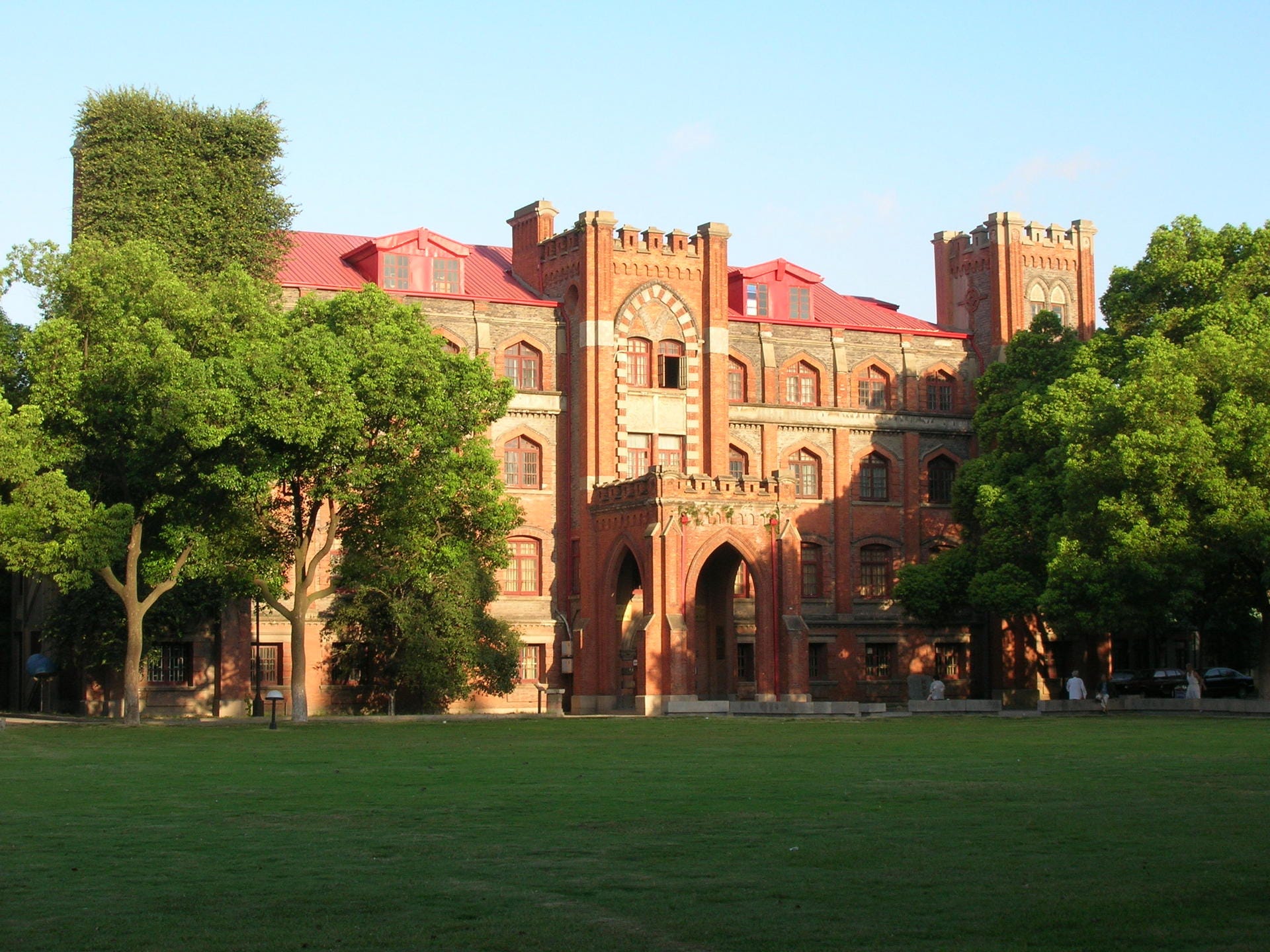
Back in 2006, China’s National Development Bank partnered with the Suzhou Industrial Park to dive into the project, bringing in Soochow University to help establish a comprehensive institution in Laos offering full-time undergraduate and graduate degrees.
By 2011, Soochow University in Laos was up and running, equipping local students with programs in international trade, international finance, Chinese language, and computer science.
Transportation stands out as another huge roadblock to Laos’s growth.
Being the only landlocked nation in Southeast Asia, Laos handles a whopping 90% of its international trade via waterways, which racks up sky-high costs.
In 2013, the Kun-Man International Highway—bankrolled jointly by China, Laos, Thailand, and the Asian Development Bank—wrapped up construction.
This became Laos’s inaugural international roadway, clocking in at 1,900 kilometers and running straight from Kunming to Bangkok.
However, highways by themselves don’t cut it; railroads are the true lifelines of a contemporary economy.
Prior to 2021, Laos only had a measly 3.5-kilometer stretch of track linking the capital Vientiane to the Thai border.
Staring down a GDP of roughly $17 billion, Laos couldn’t foot the bill for major rail projects solo, so it synced up with China’s Belt and Road Initiative.
In 2015, China and Laos sealed a railway cooperation agreement, turning the project into the second international rail venture—hot on the heels of Indonesia’s Jakarta-Bandung High-Speed Railway—to go all-in on Chinese standards.
For plenty of nations, laying tracks through rugged mountains is already a tall order, but Laos had an even bigger nightmare on its hands: the massive stockpile of unexploded bombs dumped by the U.S. during the Vietnam War.
Estimates peg the number of cluster bomblets scattered across the country at around 100 million. These live duds have posed huge safety threats to everyday life for postwar residents, fueling an oddly booming prosthetics sector in Laos.
To ensure safe construction on the China-Laos Railway, the Lao Ministry of Defense rounded up top-notch personnel, putting together 6 bomb disposal squads that slogged through five months to sweep the explosives from the entire route.
It’s fair to say that without this landmark initiative, those war leftovers tucked away in remote hillsides might have stayed buried forever, never getting the chance to be cleared out.
On December 3, 2021, the China-Laos Railway officially kicked off operations.
This passenger-and-freight line runs for 1,022 kilometers at a top design speed of 160 kilometers per hour. Once up and running, it slashed freight travel times from Yunnan’s Mohan border crossing to Vientiane from a couple of days down to under one.
Heading north, it plugs straight into China—the world’s second-biggest economy—while southward, it ties into Thailand and Malaysia’s rail systems, letting cargo zip all the way to Indian Ocean ports.
In the process, Laos flipped from being a “landlocked” nation to a “land-linked” hub.
The railway’s reliability and ease of use have pulled in a ton of corporate investments, making joint development zones near Vientiane and Luang Prabang prime real estate.
During the 2022 China International Import Expo in Shanghai, a forum spotlighting development opportunities along the China-Laos Railway wrapped up with on-the-spot deals for investments and procurements topping 10 billion yuan.
As the Belt and Road Initiative gained traction, China and Laos forged a solid complementary industrial partnership.
Laos mostly ships copper, rosewood, and farm goods to China, while snapping up cars, motorcycles, telecom gear, and electronics in return.
By 2021, pockets of the Lao population had started climbing the economic ladder, splurging on vehicles and real estate, with Vientiane’s capital even hitting gridlock levels—a telltale sign of a booming economy.
China has emerged as Laos’s top investor, pumping in tens of billions of dollars across sectors like thermal power, hydropower, and mining.
Fueled by the China-Laos Economic Corridor, the Lao economy clocked GDP growth north of 7% for a straight decade, ballooning from $7.1 billion in 2010 to $19.1 billion in 2020.
These days, Laos still ranks as a lower-middle-income country, but its poverty reduction efforts have paid off big time, with rates dropping from 46% in 1992 to 23% in 2012, and per capita GDP jumping from just over $300 in 2000 to around $2,318 in 2022.
For a nation like Laos, whose history has been riddled with hardships and outside meddling, charting its own course once felt like an impossible luxury.
China’s ascent could open up new doors for these smaller countries, showing the world that a major power’s growth doesn’t have to trample others—it can foster real mutual gains.
Folks might ask why China sinks such massive investments into an underdeveloped place like this. It’s not just altruism at play.
China’s southwestern areas share a lot in common with Laos: rugged mountains, no sea access, and slim pickings in purely domestic competition.
That said, by leveraging China’s powerhouse production capabilities and turning into the vital link between China and Southeast Asia, it could transform into a bustling economic hub with influence rippling across the region.
Shaodong in Hunan, which we touched on earlier, clocked a GDP of 68.5 billion yuan in 2021, riding the wave of that “Shaodong-Kunming-Laos” cross-border trade pipeline they put together.
Pulling back for the bigger picture, a Kunming-centered regional freight network is coming into focus, tying together China’s southwest and south-central zones while branching out to cities like Chengdu, Chongqing, Wuhan, and Xi’an.
Yunnan’s deep-rooted trade links with Laos, Vietnam, and neighboring spots have positioned it as a go-to hub for warehousing, logistics, and distribution of everything under the sun.
In addition, Southeast Asia ranks as one of the hottest prospects for pushing the RMB onto the global stage.
Laos and China rolled out cross-border RMB settlement services.
Could this pave the way for southwestern hubs like Kunming to step up as China’s key financial outposts geared toward South and Southeast Asia? We’ll have to wait and see.
As Laos emerges from the shadows of conflict and underdevelopment, its story underscores a profound truth: in an interconnected world, the rise of one power need not diminish another.
Through initiatives like the Belt and Road, China and Laos exemplify how collaboration can transform vulnerabilities into strengths, paving the way for shared growth and a brighter regional future.
Reading this made me realize how fascinating Laos’ history and geography are. I used to only know it as a landlocked country, but I didn’t know its location and terrain shaped centuries of politics, economy, and culture. The most shocking part for me was learning that the U.S. dropped over 2 million tons of bombs there during the Vietnam War—absolutely insane.
I went when I was 19. Very special place. Was welcomed in by a family run B&B at 3am. They woke up and let us sleep in the waiting area until morning. Such kind people. ❤️ 🇱🇦